What Happens Before Prediabetes?
By Chad Graue ·
·
6 min read
·
For years, there's been a quiet fight boiling in my heart.
And it's time for me to fight again.
Issue #001 of the Prediabetes Playbook is me stepping on the field with my pads on to publicly live my personal playbook to reduce my risk for Prediabetes and Type 2 Diabetes. In doing so, I want to equip others with skills, too, while raising awareness about this number:
115 Million. (More on that in a second.)
In March of this year, the Centers for Disease Control (CDC) released an update to their National Diabetes Statistics Report.
The report shared some staggering numbers, including that 40.1 million Americans in the USA alone live with known or undiagnosed Diabetes.
For me, the more staggering number is the 115 million Americans age 18 or older (43.5%) with Prediabetes.
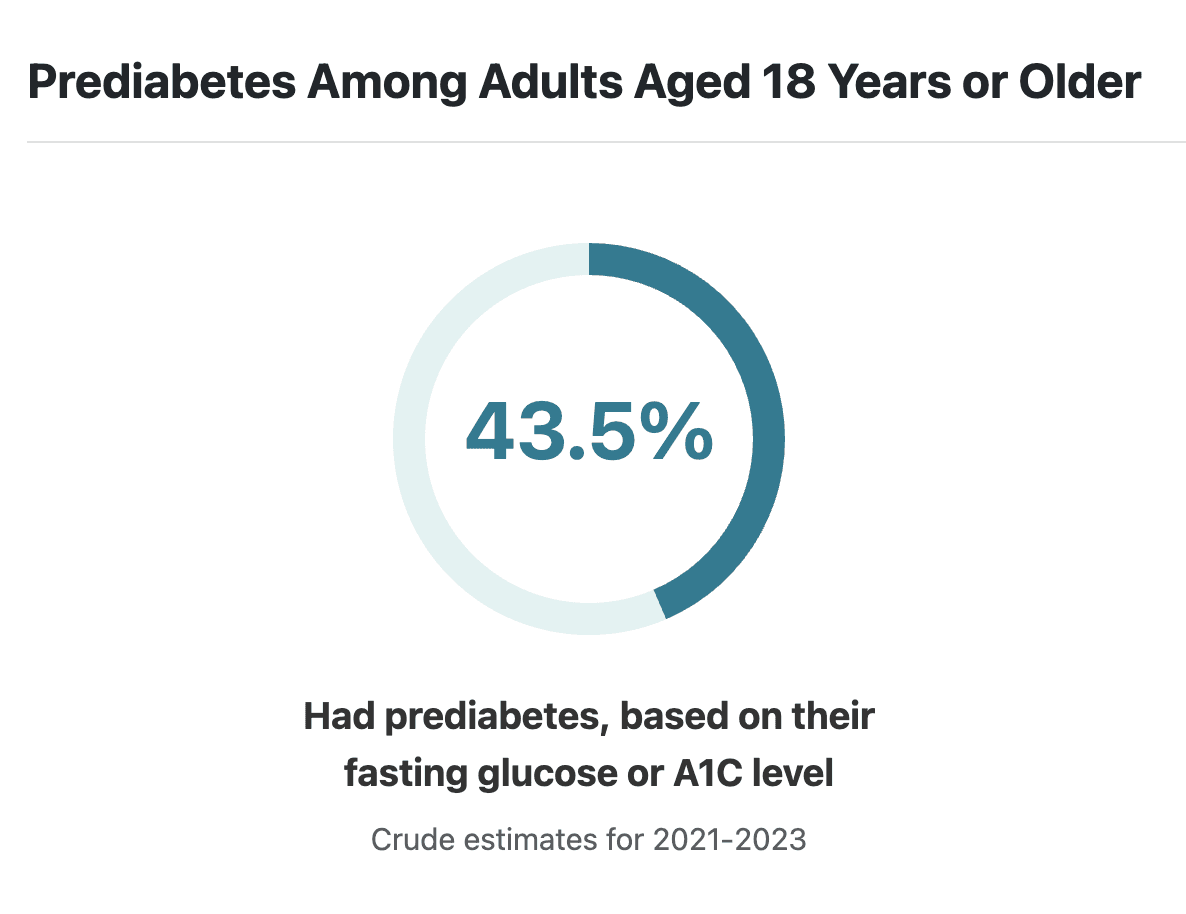
Nearly 1 in 2 adult Americans with prediabetes is a number that's hard to comprehend. And that's just ADULTS!
Prediabetes is already remarkably common in adolescents, too. The CDC estimates roughly one in three U.S. teens ages 12–17 meets laboratory criteria for prediabetes, and diagnosed Type 2 diabetes in young people has become substantially more common over the past two decades. damn.
Not to be a Debbie Downer, but I actually need to dive a little deeper yet and share my main point of view.
Can I introduce you to a concept I'd call Not Normal Normal?
That's where I am.
It's not a medical diagnosis. It's my shorthand for the years when your labs may still fall within accepted “normal” ranges, but the direction they're moving deserves your attention.
I'm meeting many healthy metabolic markers, but over the last decade-ish I've trended higher at times.
Just as prediabetics haven't yet arrived at a diagnosis of Type 2 Diabetes, there are millions of individuals who are meeting "normal" Hemoglobin A1c, fasting plasma glucose, or postprandial (after meal) blood glucose ranges, but are trending to the high end of normal over time.
Let me share an example with you as it relates to laboratory testing of fasting plasma glucose.
The normal range is < 100mg/dl.
The prediabetes range is 100 - 125mg/dL
The Type 2 Diabetes range is > 126 mg/dL
A decade or so ago, my fasting plasma glucose was often in the mid 80s - low 90s. By all accounts, normal.
Over the next few years, it was rarely in the 80s, and often in the low to mid-90s. 🤔
In the past few years, it's been most common that I'm falling in the mid to upper 90s.
I've had a few fasting plasma glucose readings just over 100mg/dL, too.
Do you see the trend? I've been mostly normal, but trending to abnormal. I like to call this trend the Not Normal Normal.
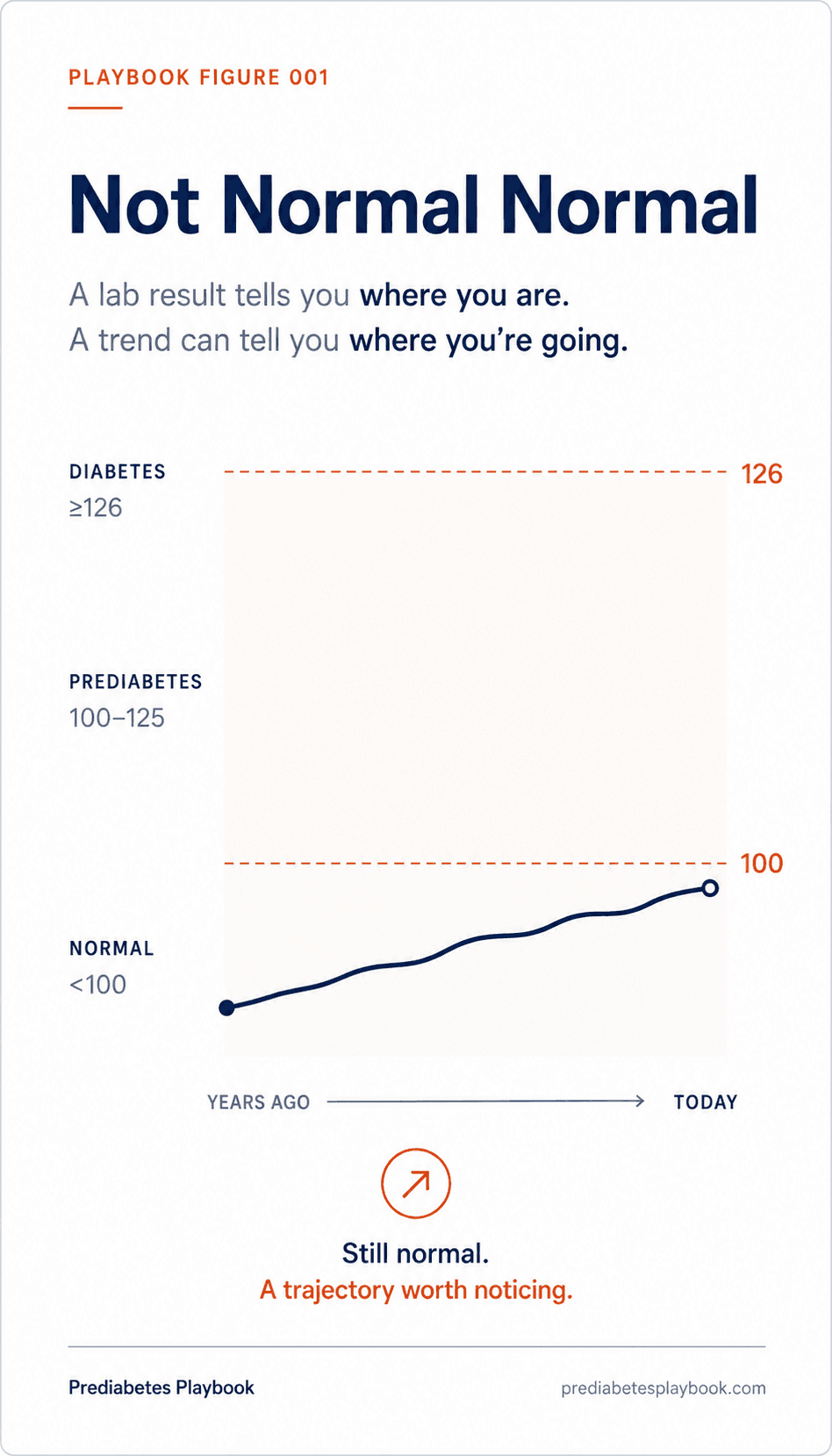
A normal result describes where you are. A trend tells you where you're going.
Let's summarize what we've unpacked so far.
We have 40.1 million adult Americans with known or undiagnosed Type 2 Diabetes, another 115 million with prediabetes, and ??? many millions more with Not Normal Normal fasting plasma glucoses (or other metabolic markers) trending towards Type 2 Diabetes.
There are more than 100 million people already living in the part of this story I care deeply about—and likely millions more moving in that direction without realizing it.
That's where I want to direct my energy and make a positive impact on public health.
After all, many of these folks can take a greater interest in their metabolic health while still living a full, healthy life of freedom, travel, meals out, and a splurge here and there.
What I'll be sharing in future issues I DO NOT view as restrictive. I love the life I live, with some guardrails that prioritize future me while being in the moment.
Let me be clear: my personal playbook is both evolving and imperfect. It's rooted in boring fundamentals: taking responsibility for knowing my numbers, moving every day, managing stress, protecting sleep, and prioritizing nourishing whole foods.
I don't claim to have all the answers, but I do have some that might unlock something for you in the coming months.
Here are 3 things I ask of you after reading this first issue:
#1 Commit to recognizing we have a public health issue here.
#2 Commit to discovering where you stand with your metabolic health in the coming months.
...Oh, and #3, commit to reading issue #002 on September 1st. 😉
Thanks for being here from the beginning.
-Chad
P.S. If you're reading this here, you missed half of the newsletter with sections From My Kitchen, On the Road, BIG WINS, and more. Subscribe here to get all of the next issue.
If you enjoyed this article, you’ll probably enjoy the next one.
Each month, I share practical ideas for staying ahead of Type 2 diabetes—before it becomes a diagnosis.